
Playing in Scottish Sinfonia
Scottish Sinfonia was founded in 1970 by its present conductor, Neil Mantle. It is a friendly amateur orchestra, which aims to play professional repertoire in a professional manner, and new members are made welcome.
How the orchestra operates
RepertoireSinfonia is a full-scale symphony orchestra, and our repertoire tends to reflect this. For instance, we have performed all the Mahler symphonies several times, and we have programmed most of the main works of Bruckner, Elgar and Strauss. We aim to cover as wide a range of periods and styles as possible.
Our concert diary gives details of our upcoming concerts, and our archive pages list all of our past programmes.
Rehearsals
Unlike other orchestras, Sinfonia does not have regular weekly rehearsals. Instead,
it assembles about three weeks before each concert, rehearsing on Sunday afternoons
(usually with one rehearsal for strings only), and on both the Saturday and Sunday
of the concert weekend.
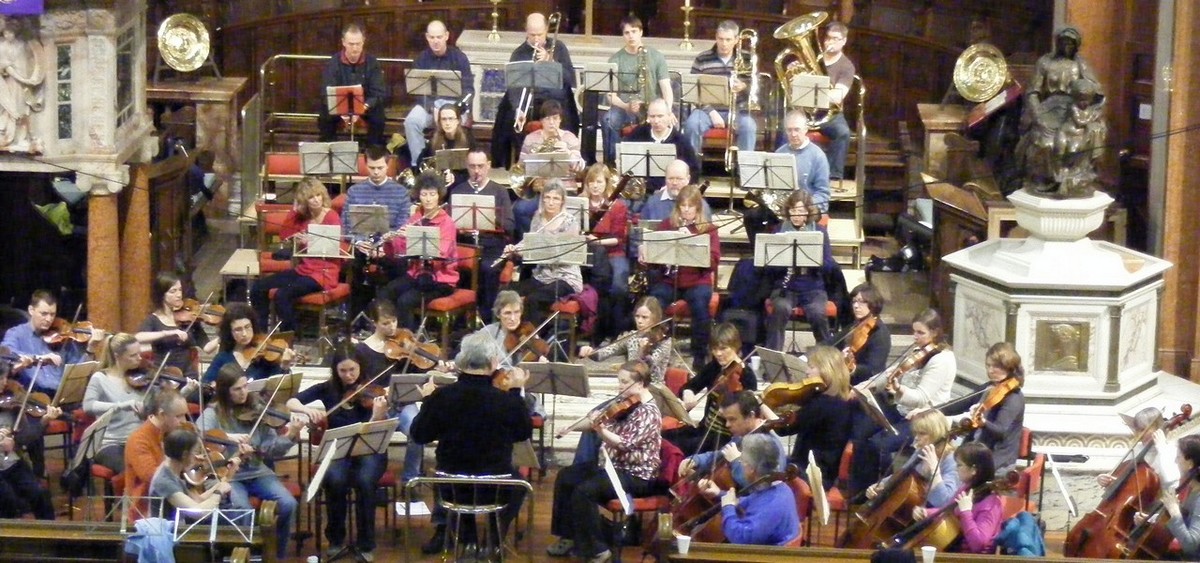
A detailed schedule is issued for each concert; a typical schedule would be:
- 1st rehearsal: Sunday, 2.15-5.30 - general play through
- 2nd rehearsal: Sunday, 2.15-5.30 - strings only (split between individual sectionals, followed by full string section rehearsal)
- 3rd rehearsal: Sunday, 2.15-5.30 - full orchestra
- Concert weekend: Saturday 10.00-1.00 and 2.00-5.00
- Sunday afternoon 2.00-5.00; then concert at 7.30.
A detailed rehearsal schedule for each concert is issued well in advance, usually during the rehearsals for the preceding concert.
Parts are generally available for individual practice in advance of the first play-through.
String section
From our pool of regular and newer players, we aim for a full symphonic strength of sixty.
Wind, Brass and Percussion sections
The main positions in these sections are held by a regular core group of players, which
is augmented from our list of regular additional players as each programme requires.
While we seldom have vacancies for regular wind players, we occasionally require substitutes,
deputies and extras, who would be invited from our standby player list.
What we expect from players
Commitment
We ask players not to miss more than one rehearsal for any concert, and we expect everyone to make
a reasonable effort to practise their parts between rehearsals. However, we don’t expect any commitment
to playing in every concert, as we know that personal availability changes from time to time, and
this sometimes creates opportunities for newer players.
Subscriptions
There are none! Because the composition of Scottish Sinfonia changes
from concert to concert, subscriptions are not appropriate. Apart from
support from a few generous sponsors, Scottish Sinfonia is funded
entirely from its own ticket sales. Therefore, we do ask the players involved
in each concert to sell some tickets!
Auditions
We ask all applicants to provide details of orchestral and other playing experience, repertoire, descriptions of orchestral groups played in, indication of playing level, and any references and/or recommendations.
Strings: Admission is by audition, which is carried out by the leader, or, in the case of viola, violincello or double bass, by the relevant section principal.
Wind, Brass and Percussion: Admission to the regular or standby player lists is by approval
of the relevant section principal, which may be following an audition where appropriate, or
by a trial appearance at a rehearsal or concert.
Contacting us (and us contacting you)
If you are interested in playing in Scottish Sinfonia, then please send
an e-mail to the Scottish Sinfonia at
webmaster@scottishsinfonia.org.uk.
Please tell us something about
your playing experience (see above), and please provide a contact phone number! It
is also helpful if wind players tell us whether they possess and play
any of the regular "extra" instruments.
You will receive an acknowledgement fairly quickly, and one of our
section secretaries will then get in touch with you in due course.
By the way, please give your e-mail a title that lets us know that it is about
playing in Sinfonia (because we get a lot of spam emails).
Follow us on social media: